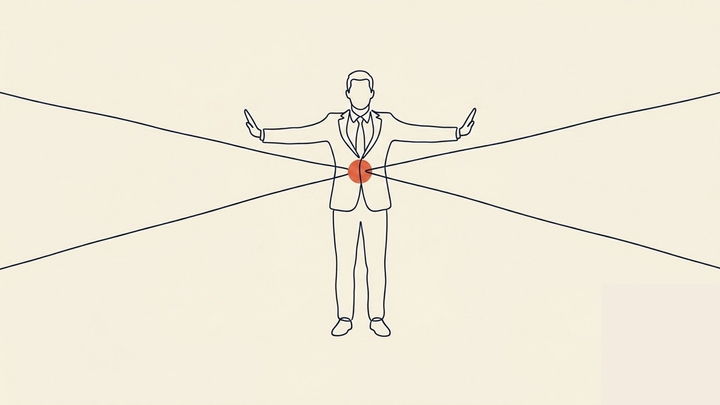
The email arrives on a Thursday afternoon. A senior team member has missed a deadline for the third time in two months. The work, when it comes, is good, genuinely good. But the pattern is becoming a problem, and two other team members have noticed.
You have about thirty seconds before you need to respond.
In that thirty seconds, most leaders feel a familiar pressure: be decisive or be empathetic. Hold the standard or protect the relationship. Be the kind of leader who doesn't let things slide or be the kind of leader people want to work for.
Choose.
This is the moment where false binaries do their most damage. Not in the big strategic decisions, which usually have enough runway for deliberation. In the small, fast, human moments where a leader reaches for a category and acts from it before they have time to think.
The Binary Is Not the Choice
I have sat in that thirty-second gap more times than I can count, my own, and for thirty years, other people's. I have watched steady, capable leaders reach for a category and act from it before they had time to think, and I have done it myself. What I keep coming back to is that the category is almost never the real choice.
Leaders are handed binaries constantly. Strong or empathetic. Visionary or operational. Direct or compassionate. High standards or high trust. The framing implies a choice between two real options. In almost every case, it isn't.
These are not competing values. They are complementary ones that have been artificially separated, usually by a leadership culture that has decided complexity is weakness and certainty is strength.
The leader who is only decisive, without empathy, makes fast decisions that erode the trust required to execute them. The leader who is only empathetic, without clarity, protects the relationship while letting the work deteriorate. Neither is actually effective. Both are incomplete.
What looks like a choice between two options is almost always a failure to hold both.
What looks like a choice between two options is almost always a failure to hold both.
What Integration Actually Means
Integration is not balance. This distinction matters.
Balance implies a midpoint, a careful calibration of two opposing forces so neither wins. It is defensive by nature. It asks: how much of each can I tolerate without tipping too far in either direction?
Integration asks a different question entirely: what becomes available when I bring both fully to bear?
The decisive leader who is also deeply empathetic does not make half-decisive, half-empathetic decisions. They make decisions with more information, because they understand what the decision means to the people it affects, and they communicate those decisions in a way the team can actually hear, because the empathy is not performance but genuine curiosity about human experience.
The two qualities do not dilute each other. They amplify each other.
Integration is what leadership asks for when a moment seems to demand a choice between being decisive and being empathetic, between holding a high standard and offering real care. It is not balance, the defensive midpoint where two forces are calibrated so neither wins. It is the more demanding practice of holding both fully, until the apparent choice dissolves. Integration is not the mediocre middle. It is the practice of looking longer, refusing to simplify before you have seen what is actually there.
Integration is more demanding than choosing a side. Choosing a side is clean. It has an identity. You can build a reputation around it. Integration requires you to hold the tension of both without resolving it prematurely, which means you have to stay in contact with the complexity longer than most leaders are comfortable with.
That discomfort is usually where the best leadership decisions come from.
Integration is not the soft middle ground between two options. It is the more demanding path of holding both without collapsing into either.
Where the Pressure Comes From
The pressure to choose is not accidental. It is structural.
Most leadership environments reward decisiveness as a signal of confidence and punish ambiguity as a signal of weakness. Expressing care for a team member's situation can read as making excuses for underperformance. Holding a high standard can read as lacking emotional intelligence. The culture reads integration as confusion and calls it by more flattering names: inconsistency, indecisiveness, being soft.
The cost shows up later. In teams that are compliant but not committed. In cultures where people do what they are told but don't bring what they actually know. In leaders who are technically successful and quietly exhausted by the effort of maintaining the performance.
The binary is not just a thinking error. It is a survival adaptation to an environment that has been punishing integration for a long time.
Systems built on the separation of head and heart, strength and care, performance and humanity, end up producing leaders who have amputated the parts of themselves the system doesn't reward.
The Choice Was Never Where It Started
The pressure to choose shows up in a single moment of action, the thirty seconds before the reply. But by the time a leader is reaching for a side, the deciding work is already behind them, or already missing.
Whether you can hold both decisiveness and care in that moment depends on something settled long before the email arrived: how grounded you are in who you actually are, and how clearly you see the person and the situation in front of you. A leader who has lost contact with their own values, or who doesn't really see the human on the other end, has nothing to integrate from. They reach for the nearest category because it is the only thing available.
So the binary is not really a decision problem. It is what a decision looks like when it has been cut off from the self making it and the people it lands on. You cannot hold together in action what you have not first remembered in yourself. Integration is not a technique you apply at the moment of choosing. It is what becomes available in the choosing when the ground underneath it is whole.
Staying With What's Actually There
None of this arrives at once. It builds slowly, in the small moments, and it usually begins with catching the binary before you act from it. The thirty-second window is enough time, if you use it. The question in that window is not which side to choose but whether the choice is real at all, and most of the time it isn't. Naming the false constraint, silently or on the page, opens enough room to ask what holding both would look like instead.
Underneath the reach for a side there is almost always a fear. Decisiveness can feel like protection against being seen as weak, and care like protection against being seen as cold. The fear isn't foolish, because the environment often will judge one quality or the other. But a decision made to protect yourself is not the same as one made from what you actually value, and it is the self-protection, not the situation, that collapses the moment into a binary. It is worth asking what you are guarding, and whether it is worth the cost of the smaller, safer, half-true decision.
And then the harder thing, staying in the discomfort a little longer than you want to. The instinct is to resolve the tension fast, to get out of the not-knowing. Integration asks you to remain in contact with both sides until you can feel what each is pointing toward. This is not indecision. It is the recognition that premature resolution is usually just avoidance with better PR.
Premature resolution is usually just avoidance with better PR.
What Becomes Available
Back to the Thursday afternoon email.
The leader who integrates does not choose between holding the standard and caring for the person. They do both, in sequence or at once, because both are true. They address the pattern directly, because the work matters, and because the team is watching, and because being honest about impact is a form of care. And they do it in a way that acknowledges what they actually know about this person, the quality of their work, the pattern's likely cause, the relationship they have built, because none of that context is irrelevant to how the conversation goes.
This is not more time-consuming than choosing a side. It is more honest. And it is more effective, because it treats the situation as what it actually is: complicated, human, and worth getting right.
I have needed this as much as anyone I have sat across from.
The middle that integrated leadership inhabits is not the mediocre middle. It is not a compromise between two better options. It is the only place from which a leader can actually see the full picture, and act from it.
Most of what makes leadership hard is not the absence of the right answer. It is the pressure to simplify before you have looked long enough to see what is actually there.
Integration is the practice of looking longer.
This week, identify one decision where you felt pressured to choose between two values: strength or compassion, clarity or flexibility, directness or care. Before responding, write down what each option would cost, not the strategic cost but the human cost to the people involved and to your own integrity. Then ask: what would a decision that honoured both actually look like? You do not have to find the perfect answer. You have to stay in the question long enough to discover there was never really a choice.
The Weekly Alignment
One short piece each week. Not advice, and nothing to keep up with. A reminder, arriving on a Thursday, that the ground was always there.
Unsubscribe any time. Nothing else is sent.


