The leadership team meeting is already running over.
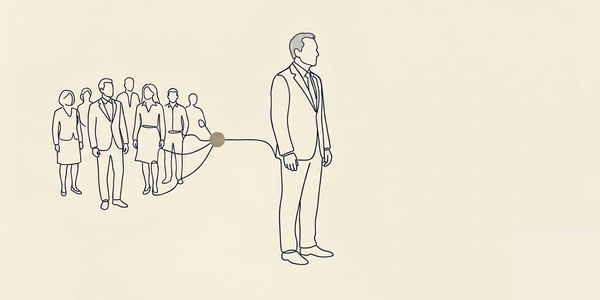
Everyone is looking at the same data. The projections are uncomfortable. Nobody in the room is entirely sure what happens next. They are looking at the leader.
And the leader, in this moment, is looking at the same data they are.
I've sat at the head of that table, and for thirty years I've watched it from the side. This is the real test of leadership in uncertain conditions, and it isn't the strategy session or the communication plan. It's this moment, when the room needs something from the person at the front that has nothing to do with having the right answer and everything to do with who that person actually is.
What Organizations Actually Need
Give an organization a leader who is genuinely steady when the ground moves, and something opens that no strategy can manufacture: the room stops bracing and starts thinking, people bring their own judgement back online, and the actual problem gets worked instead of the leader's mood. That steadiness is the most valuable thing an organization has in a volatile stretch, and it is almost never the thing leadership development is pointed at.
The conventional answer to what organizations need from leaders in uncertainty is clarity, communication, a sound strategy. None of it is wrong. But all of it sits downstream of something more fundamental that most leadership development never names directly.
That thing is steadiness. Not the performance of calm, the visible composure leadership culture rewards and that experienced leaders can hold even while managing real internal anxiety, but actual steadiness: the interior state decisions get made from without being driven by fear, where the leader is genuinely present to the situation rather than managing their own response to it.
The distinction matters because teams can feel the difference. Not always consciously, not always immediately, but over time. They can feel whether the leader is steady or whether the leader is performing steadiness while managing something that has not been acknowledged. The performance is functional for a while. The gap it conceals eventually creates problems that are harder to address than the original uncertainty.
Teams can feel the difference between a leader who is steady and a leader who is performing steadiness while secretly managing panic.
Why Leaders Lose Their Steadiness
Leaders do not lose steadiness in uncertain conditions because they are weak or underprepared. They lose it for the same reasons their teams do: the uncertainty is real, the stakes are genuine, and the absence of reliable information triggers exactly the kind of anxiety that human beings evolved to feel in threatening conditions.
The specific vulnerability for leaders is structural. They are in a position where the expectation is that they have answers, or at minimum that they are more oriented than the people around them. When they are not, when they are genuinely uncertain, genuinely anxious, genuinely without a clear path forward, the social pressure of the leadership role creates a specific additional stress: the pressure to perform certainty they do not have.
This performance is exhausting and, over time, self-undermining. The energy required to manage the gap between the leader's actual interior state and their performed exterior state is significant, and it is energy that is not available for the actual work of navigating the uncertainty.
There is a better path, and it runs the other way. It asks a leader not to build a new capability but to reclaim one they already have, through interior work most leadership development never asks for.
The energy required to perform certainty you don't have is not available for the actual work of navigating uncertainty.
The Difference Between Performing Calm and Being Grounded
Steadiness is the interior state a leader decides from without being driven by fear: in full contact with it, not governed by it, present to the situation rather than managing their own reaction to it. It is the opposite of performing calm, which manages the visible surface while the fear runs underneath. A team feels the difference, registering a steady leader as a fixed point, not for having the answers but for being genuinely available. It is an organization's most valuable resource when the ground moves, and it cannot be performed sustainably. It has to be real.
Performing calm is a management strategy. It is the leader modulating their visible affect, the tone of voice, the body language, the language choices, to project a state of composure that they may or may not be experiencing. It is a skill, and a useful one in specific situations.
Grounded is a different thing altogether. Being grounded is not a performance of internal stability. It is internal stability. The leader who is genuinely grounded in a crisis is not suppressing their fear or their uncertainty. They are in full contact with it, and they are not being governed by it. They can feel what the situation actually requires without the noise of their own anxiety distorting the signal.
This is not a personality trait, not something some leaders are born with and others aren't. It is a capacity every leader already carries and can reclaim, recovered through specific interior work: understanding your own triggers, your own fear responses, your own relationship with uncertainty. And it is work done before the crisis creates the need for it, not during.
What the Interior Work Looks Like
The leaders who are most reliably steady in uncertain conditions have almost always done one specific thing: they have developed an honest relationship with their own fear. Not suppressed it, not transcended it, not performed its absence. Developed an honest relationship with it.
They know what their fear feels like. They know what it tells them to do, the specific pulls toward control, or avoidance, or urgency that their particular fear pattern produces. And they have developed enough awareness of those pulls that they can feel them without following them. They can stay in the discomfort of not knowing without the discomfort dictating their decisions.
This is what steady looks like from the inside. Not the absence of anxiety but the presence of something else alongside it: the capacity to stay in contact with your own values and judgement even when the situation is pressing for reaction.
The team experiences this as a fixed point. Not because the leader has all the answers, but because the leader is genuinely available to the situation rather than managing their own response to it. That availability is what a team actually reads as calm, and it is the thing the organization has been needing all along. It cannot be performed sustainably. It has to be real.
The team experiences a grounded leader as a fixed point. Not because they have the answers, but because they are genuinely available to the situation.
Before your next team meeting in a genuinely uncertain stretch, take two minutes alone. Notice your internal state, not to manage it but to name it honestly. What are you actually feeling? What's driving it? What does that feeling want you to do once you're in the room? Then ask what the situation actually requires, separate from what the feeling is pulling you toward. Walk in from there, and lead from the second answer, not the first.
The Weekly Alignment
One short piece each week. Not advice, and nothing to keep up with. A reminder, arriving on a Thursday, that the ground was always there.
Unsubscribe any time. Nothing else is sent.